A Plinko screen can look simple: choose settings, watch a ball move and see a multiplier. The meaningful comparison sits behind that animation. You need the exact game provider, row count, payout table, probability mapping and settlement rules. A larger displayed multiplier does not explain how often it can occur, and a setting labelled “low risk” does not mean there is no possibility of losing money.
The casino list accompanying this article is filtered for documented Plinko availability. It is a route to the operator profiles, not a statement that every Plinko game shares one mathematical model. Read the main Plinko comparison for the broader guide, then use this article to inspect settings and payout descriptions in more detail.
Start with the game identity
Plinko is a format used by different providers. A familiar board shape does not establish identical rules. Record the title, provider, available settings and the version information supplied by the game. If a casino lists more than one Plinko title, a fairness statement for one should not be applied to the others.
The same discipline applies to screenshots. A payout table captured with one row count and risk setting may not describe another configuration. A good review keeps the settings and the table together. If the selected configuration is not visible in the evidence, the screenshot cannot support a precise comparison.
Read every payout bin, not just the largest
The largest multiplier usually draws attention, but the complete table determines how returns are distributed. Record the value assigned to every possible outcome and the probabilities or mapping supplied by the provider. A high maximum can coexist with many outcomes returning less than the stake. Without the full distribution, the maximum alone cannot establish a favourable game.
Also confirm whether a displayed multiplier describes the total return including the stake or a profit amount. In a hypothetical total-return model, a two-unit wager landing at 0.5 times returns one unit and loses one unit net. At 1 times, it returns the original two units before any separate costs. These examples explain the arithmetic; the actual game’s definitions still need checking.
Row count and probability need a stated model
It is tempting to assume that every on-screen bounce behaves like a physical coin toss. That assumption needs evidence. A game may describe a particular algorithm for translating random values into movement or a final bin. The animation is a presentation of the result and is not, by itself, a technical specification of the probability model.
Stake publishes game-event documentation that includes a Plinko mapping, alongside its general implementation material. Such documentation can support an examination of that specific implementation. It should not be treated as a universal rule for every provider or every version of the game. A comparison needs to match the source to the title being described.
An illustrative board with explicit probabilities
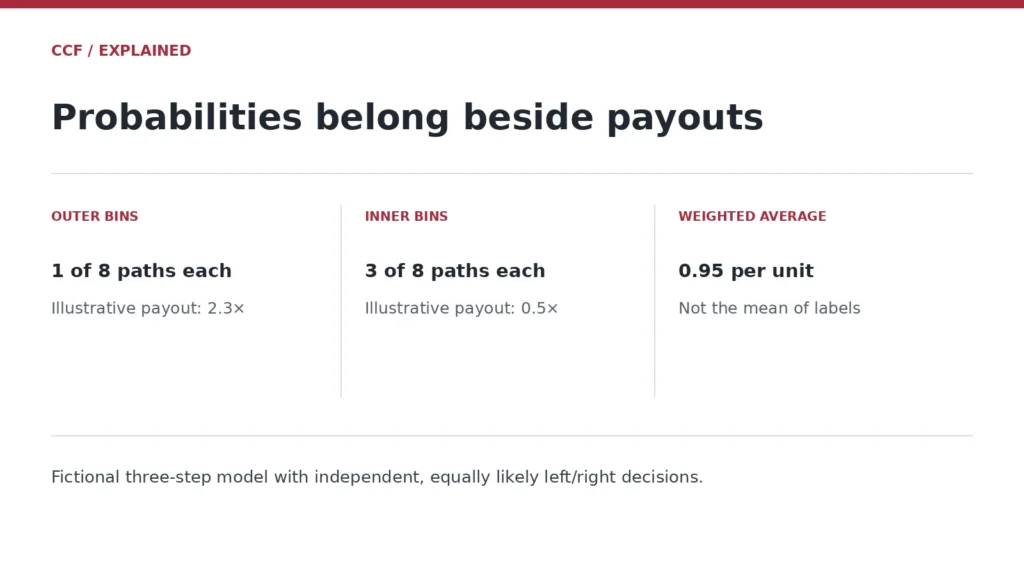
To see why probabilities matter, imagine a fictional board with three independent left-or-right decisions, each equally likely. There are eight equally likely paths. The four final bins have path counts of one, three, three and one. Their probabilities are therefore one-eighth, three-eighths, three-eighths and one-eighth. This is an invented teaching model, not a statement about a current casino product.
| Final bin | Path count | Probability | Illustrative total-return multiplier |
|---|---|---|---|
| Left edge | 1 | 12.5% | 2.3× |
| Inner left | 3 | 37.5% | 0.5× |
| Inner right | 3 | 37.5% | 0.5× |
| Right edge | 1 | 12.5% | 2.3× |
Multiplying each probability by its multiplier and adding the results gives 0.95 units of average total return per unit staked in this fictional model. Simply averaging the four printed multipliers would give the wrong answer because the bins are not equally likely. That is the central lesson: a payout table without its probability model is incomplete.
The example does not predict a short sequence of outcomes. Even a correctly calculated average does not promise that a person’s balance will follow that average over a limited session. It also does not describe what happens in a real game with a different row count, mapping, cap or payout configuration.
What a risk setting changes
A setting may change the payout distribution while leaving other aspects of the interface similar. To compare settings, examine the full table and any provider-defined return figures. Do not assume that “high risk” means a higher average return or that “low risk” protects a deposit. Those labels need to be read in the context supplied by the game.
A useful review explains which settings were documented and avoids claiming to have tested all configurations when only one was inspected. It should also avoid turning the most dramatic screenshot into the default description. A screenshot with an extreme multiplier can describe an unusual configuration rather than the one a reader will see first.
Verification is a separate evidence layer
A provably fair mechanism can help reproduce a recorded result when the required inputs and algorithm are available. That does not establish that the payout table is profitable or that an operator will honour a future withdrawal. The calculation and the account relationship are different questions.
For a reproducible record, retain the game identity, settings, round identifier, relevant commitment, revealed inputs and mapping rules. Record whether the result was actually reproduced or whether only the documentation was read. Our verification guide explains this distinction using another game format; the specific Plinko implementation still requires its own documentation.
Track total exposure when several balls are involved
A small per-ball stake can conceal a larger cumulative amount if a user launches many rounds. In a hypothetical example, 40 rounds at 0.50 units each represent 20 units of turnover. The number remains 20 even if the interface makes the sequence look like a brief animation. Turnover is not the same as the final net result, but it is important for understanding how much wagering occurred.
If a game offers automatic or repeated actions, read how they start and stop and what the account records. This is not an endorsement of automatic play. A comparison should make the controls and limits understandable and should not encourage a reader to increase the number of rounds to chase a theoretical average.
Crypto balances can obscure stake size
Identify the unit debited by the game and the unit displayed beside the stake. A decimal denominated in BTC may be accompanied by a changing estimate in another currency. A USDT display can still involve conversion inside an operator’s account. The important question is how the actual ledger records each wager.
Separate this payment question from the game model. Funding the same configuration through another asset does not, by itself, establish a different probability distribution. The BTC-versus-USDT guide explains the accounting distinctions that belong in a payment comparison rather than a claim about winning chances.
Check bonus eligibility before using a contribution figure
A casino promotion may treat original games, table games or specific titles differently. Do not assume that Plinko contributes to wagering simply because it appears in the casino lobby. Read the current offer’s eligible-game list, contribution rate, maximum stake and any other restriction.
For an invented bonus target of 1,000 credited units, a 10% contribution would require 10,000 units of eligible wagers under a simple constant-rate model. At zero contribution, no amount of play in that game completes the target. The calculator makes those cases explicit without predicting losses or recommending that anyone pursue the target.
A practical Plinko comparison checklist
- Identify the provider and precise game title.
- Record row count and selected risk setting with the payout table.
- Confirm whether multipliers describe total return or profit.
- Find the documented probability mapping and any theoretical-return figure.
- Distinguish documentation review from a reproduced result.
- Record the account unit and cumulative stake across repeated rounds.
- Check promotion eligibility and contribution separately.
- Read interruption, dispute and account-withdrawal conditions.
The checklist also gives editors a way to update a page responsibly. A changed configuration requires a new source check. A changed month in the headline does not supply new mathematical evidence. Keep the source date, version and any actual test details attached to the relevant claim.
Questions about Plinko settings
Does the centre bin always have the highest probability?
Do not infer that from the drawing alone. The answer depends on the game’s documented mapping. The three-step illustration in this article uses explicit equal left-or-right decisions, but a real title needs its own evidence.
Can a high maximum multiplier compensate for every loss?
A maximum is a possible outcome under particular rules, not a promise of occurrence. Its probability and the other outcomes matter. Chasing a rare result can lead to further losses and is not a sound way to resolve an earlier loss.
Does passing a fairness check remove gambling risk?
No. A consistent result-generation mechanism can coexist with unfavourable expected returns, volatile outcomes and separate account restrictions. It also says nothing about whether a person’s spending limit is appropriate.
Use the information to understand the game, including reasons to avoid it. Set any limits before interacting with promotions, stop if control becomes difficult and consult our responsible gambling resources for support. The operator profiles are documentary comparisons, not a promise about eligibility, winnings or future payments.
Keep a settings change in the record
Suppose an article compares two screenshots, one taken with eight rows and another with sixteen. Even if both display the same risk label, their bin counts and payout tables need to be documented separately. Write one row in the research worksheet for each configuration, and attach the corresponding evidence. If the provider changes the available settings, retain the earlier observation as historical rather than silently merging it into the new one. This makes a correction possible without implying that an earlier screenshot described every version of the game.
Sources & further reading
Found a factual error or an outdated term? Send a correction
Our editorial standards →