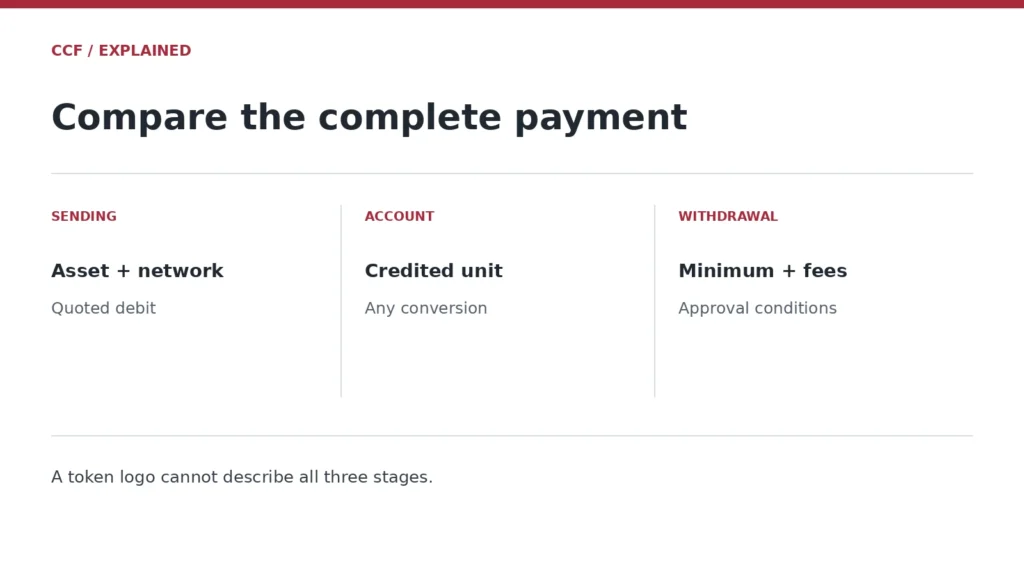
Comparing Bitcoin and USDT casino payments requires more than asking which transfer looks cheaper. You need to know what leaves the sending account, the route used to deliver it, the unit credited by the casino and the conditions for taking a remaining balance out. A familiar asset name can conceal a different network or an automatic conversion.
This article compares payment structures rather than recommending a cryptocurrency purchase. The accompanying casino list uses shared operator records; it does not establish that every listed brand supports every possible BTC or USDT route. Read the Bitcoin guide and USDT guide for the respective profile lists, then apply the same worksheet to the exact cashier route you are researching.
Begin with the account unit
The first comparison is between account ledgers, not logos. Does the operator retain BTC, retain USDT, or convert either deposit into another currency? Is a displayed dollar amount the actual account balance or merely an estimate? Does the withdrawal use the original asset, a chosen asset or a conversion service? A clear review should answer these questions before displaying a fee comparison.
Suppose two fictional accounts begin with a displayed value of 100 dollars. One holds a fixed quantity of BTC before any wagers. The other records 100 USDT. Their exposure to price changes differs, but so can their counterparty and withdrawal conditions. Neither arrangement guarantees that 100 dollars will be available later. Game results, fees, conversion spreads, token pricing and account access all need separate consideration.
It is especially important to distinguish a promotional balance from an ordinary balance. A dashboard may combine them visually even when the rules do not permit both to be withdrawn. Record cash balance, bonus balance and the amount currently eligible for withdrawal as separate fields. Otherwise an apparently simple BTC-versus-USDT comparison can accidentally compare different kinds of balance.
The network is part of the payment method
Tether publishes supported-protocol documentation because its tokens exist on multiple networks. A casino’s acceptance of USDT on one network does not establish acceptance on another. For BTC, also verify the exact route described by the receiving service rather than assuming that every product containing the word Bitcoin is interchangeable.
Write the payment method as an asset-and-network pair. Then add the sending platform, receiving operator and any intermediary. This fuller description makes disagreements visible. For example, a sending exchange might offer a low-priced withdrawal route that the receiving casino does not list. The attractive fee is irrelevant if the route is incompatible. Do not substitute a network because its address format looks familiar.
| Field | Bitcoin route | USDT route |
|---|---|---|
| Asset and network | Record the exact BTC route | Record USDT plus the named blockchain |
| Casino ledger | BTC balance or conversion? | Token balance or conversion? |
| Sending cost | Wallet or exchange quote | Token-transfer or exchange quote |
| Withdrawal conditions | Minimum, fee and approval requirements | Minimum, fee, network and approval requirements |
| Value comparison | Dated conversion if needed | Do not silently assume an exact dollar redemption |
Separate four possible costs
A useful total-cost worksheet distinguishes the sending fee, any deposit conversion, the operator’s withdrawal deduction and any receiving or conversion cost. Those charges may be paid to different parties. An operator advertising no platform fee has not necessarily removed a sending exchange’s charge, a blockchain fee or the cost of changing the final balance into another asset.
Use an invented example to see why the distinction matters. Route A requires a sending-service charge of 1 unit and a later withdrawal deduction of 2 units. Route B quotes no operator withdrawal deduction but requires a 4-unit sending charge. Before conversion effects or other conditions, the recorded charges are 3 and 4 units respectively. That does not identify a universally better route; the units, available balance, minimums and account restrictions must still match.
Keep percentage charges separate from fixed charges. A fixed 2-unit fee represents a different fraction of a 20-unit request and a 200-unit request. A percentage conversion spread scales with the converted amount. Combining them into a single “low fees” label hides the detail readers need. Our payment comparison tool shows published fields without converting missing values into zero.
Minimums can matter more than a small fee difference
Deposit minimums and withdrawal minimums are independent conditions. An accepted deposit does not prove that the same amount is large enough for a later withdrawal. The threshold may also depend on the selected route. Check whether the stated amount must be sent, received, requested or available after deductions. These are not necessarily the same number.
For a hypothetical account with 19 units available and a 20-unit withdrawal minimum, the arithmetic alone leaves the request below the threshold. It does not justify depositing additional money or gambling to try to increase the balance. The appropriate next step is to clarify the operator’s policy for small residual balances and account closure. A comparison should identify this issue before a user is committed to an account.
Native units deserve particular care. A figure written in BTC should not be compared numerically with one written in USDT. If an article uses a common currency, it should provide the conversion time and source. Because exchange values change, a converted figure can become stale even when the underlying minimum has not changed.
Stablecoin wording needs precision
USDT is designed around a dollar reference, but a casino balance displaying USDT should not be described as a protected bank deposit or a guaranteed cash redemption. Token arrangements, market pricing and access to redemption are different questions from the casino’s own obligation to process a withdrawal. A comparison should preserve those distinctions rather than presenting the word “stable” as a complete risk description.
For research purposes, ask which quantity is fixed in the account and which quantity is merely displayed. If a game stake is denominated in dollars but funded by a token balance, determine when conversion occurs and which rate is used. The same question applies to BTC. A rate shown on a marketing page may not be the rate used when an actual account transaction is executed.
Do not confuse network activity with payment approval
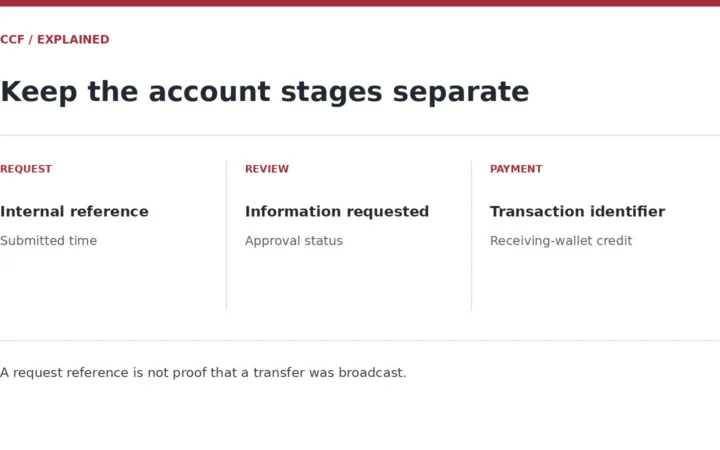
A faster-moving network does not establish a faster end-to-end casino withdrawal. The operator may review the account, verify documents or apply other published conditions before broadcasting anything. After broadcast, a receiving service can have its own crediting requirement. A fair comparison needs timestamps for those stages, not a mixture of a measured network event and an untested marketing claim.
Consider two fictional timelines. In one, approval takes several hours and network delivery is brief. In the other, approval is brief but the receiving service waits longer before crediting. Describing only the chain segment would misrepresent the experience. Our existing withdrawal guide provides fields for the whole timeline; no unperformed payment test is implied by this explanation.
Verification and bonus restrictions still apply
Neither BTC nor USDT determines whether an operator will request identity information. Read the account policy and payment conditions for the exact service. The relevant questions include who may own the sending method, which documents can be requested, how support communicates and whether any condition must be satisfied before requesting a withdrawal.
Likewise, the payment asset does not settle bonus eligibility. A promotion may identify eligible payment methods, account currencies or game categories. An offer that appears identical in two banners can have different maximum bets or conversion rules. Use the bonus conditions guide and keep ordinary deposit turnover separate from bonus wagering.
Build a comparison that another reader can reproduce
- Record the operator’s exact domain and the page or cashier screen describing the route.
- Write the asset, network and underlying account unit without abbreviating away the differences.
- Copy numerical fields into separate columns for deposit minimum, withdrawal minimum and quoted deductions.
- Label each field as publicly documented, account-specific, unknown or observed in a completed test.
- Note the source-check date and retain the actual source URL.
- List verification, turnover and eligibility conditions alongside the numbers.
- Explain any disagreement between the help page, general terms and account quote.
This structure is useful even if several fields remain blank. The honest result of research might be that one route is described publicly while another requires an account quote. That is a difference in evidence coverage, not proof of a difference in quality. Do not award a favourable score simply because the unknown fields were omitted from the table.
Three common comparison mistakes
Using a token logo as a network guarantee
A logo does not state a chain, contract, minimum or receiving condition. Check the current cashier instructions. Our USDT network guide explains how to turn those labels into a complete route description without guessing compatibility.
Calling a zero operator fee a free transfer
The operator may describe only its own charge. A sender or intermediary can quote a separate fee. Record who charges each amount and whether it is added to the debit or deducted from the recipient’s credit. That makes the cost claim specific enough to check.
Treating asset choice as a game strategy
Funding a game with a different cryptocurrency does not establish different winning probabilities. The relevant evidence is the game configuration and its rules. Separate the cost of the payment route from the expected behaviour of the game; otherwise a payment comparison becomes an unsupported claim about gambling outcomes.
What to take from the comparison
The useful outcome is a clearly described, eligible payment route with understandable conditions. There may be no suitable route, and uncertainty is a valid reason not to proceed. Do not purchase an asset or add a deposit merely to fit a promotion. Keep essential-expense money separate from any gambling budget and review our support information if gambling is becoming difficult to control.
The monthly title is an edition label. Operator terms, network options and fees require their own dated checks. If a source changes, the comparison needs a substantive review; changing the month does not establish that every underlying fact was reverified.
Sources & further reading
- Bitcoin.org: payment and wallet considerations ↗bitcoin.org
- Tether: supported protocols ↗tether.to
- Ethereum.org: gas and fees ↗ethereum.org
Found a factual error or an outdated term? Send a correction
Our editorial standards →