Slot RTP and volatility answer different questions. Return to player describes a theoretical relationship between stakes and returns under a game’s specified model. Volatility describes how uneven outcomes can be. Neither tells an individual player what will happen in the next session, and neither can be inferred from the cryptocurrency used to fund an account.
This guide explains how to compare the actual version of a slot rather than a headline percentage copied from another site. The accompanying list is filtered for documented slot availability. It does not assign one RTP to an entire casino. Our crypto slots comparison introduces the operator profiles; the worksheet here helps identify what evidence a particular game comparison needs.
RTP is a property of a defined model
A theoretical RTP needs a specified game, configuration and set of assumptions. A percentage without those details is incomplete. The UK Gambling Commission’s explanation of return to player distinguishes a long-run average from the outcome of a playing session. That distinction is essential when a promotional page places a percentage next to an invitation to play.
For a simple invented model with 96% theoretical RTP, the corresponding long-run average return on 1,000 units of turnover is 960 units under the model’s assumptions. That is not a promise that a 1,000-unit deposit will end as 960 units. Turnover can include the same balance being wagered repeatedly, and the distribution of actual results can be very wide.
The difference between deposit and turnover deserves emphasis. A person could deposit 20 units and place many small wagers while recycling returned amounts. The cumulative amount wagered can exceed the deposit even though the person never had that cumulative amount available as cash. Calculations that multiply RTP by the original deposit often confuse these two quantities.
Volatility concerns the shape of outcomes
Two hypothetical games can have the same average return and distribute it differently. One may return smaller amounts more frequently; another may concentrate more of its modelled return in rarer large outcomes. The average alone cannot describe the experience of a short session. A volatility label tries to communicate that difference, but its meaning should be checked with the provider.
Do not assume that “low”, “medium” and “high” form a standard scale shared by every provider. A useful review identifies the source of the label and avoids treating it as a precise universal measurement. If no numerical definition is available, say so. A qualitative label can still help describe a game, but it should not be converted into an invented probability of keeping a balance.
An original example: equal averages, different distributions
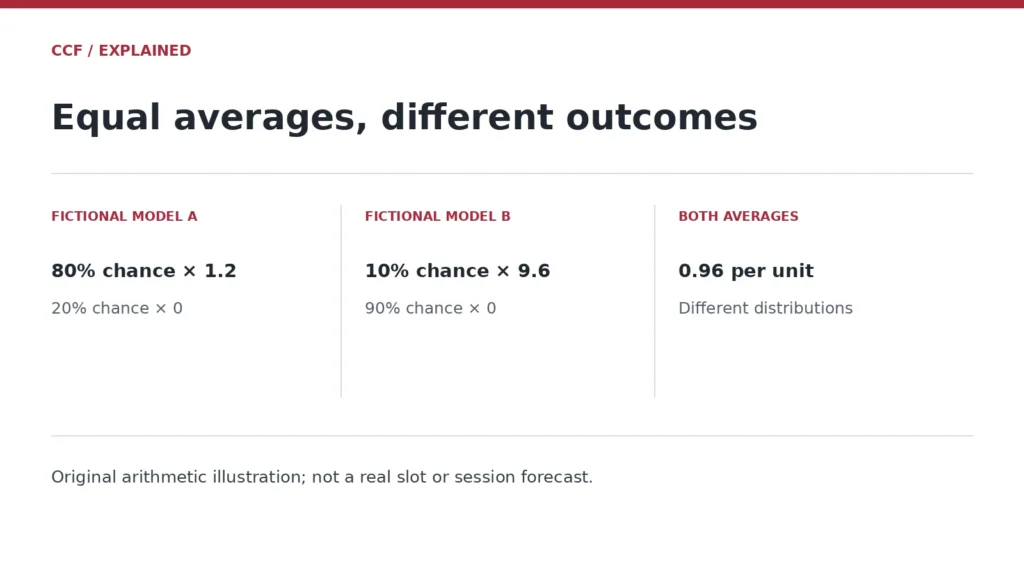
Consider two deliberately simplified fictional games with a one-unit stake. Game A returns 1.2 units with probability 80% and zero otherwise. Its average return is 0.96 units. Game B returns 9.6 units with probability 10% and zero otherwise. Its average is also 0.96 units. The examples are mathematical illustrations, not descriptions of real slots.
| Model | Non-zero return | Probability | Average total return |
|---|---|---|---|
| A | 1.2 units | 80% | 0.96 units |
| B | 9.6 units | 10% | 0.96 units |
The second model has many more zero-return outcomes and a larger occasional return. Matching averages do not make their short sequences look alike. Nor does the example suggest that either game should be played. It simply demonstrates why an RTP comparison without a distribution discussion leaves out information.
A real slot can be far more complicated, with multiple prizes, features and configurations. A public volatility label is not enough to reconstruct that distribution. Avoid filling the gap with a claim that a bonus round is “due” after a certain number of spins. A short visible history does not establish such a schedule.
Find the version actually available
Record the game name, provider and information screen visible in the operator’s version. If a provider or operator supplies several configurations, the relevant figure is the one attached to the actual game being researched. A generic review can be out of date or refer to a different version even when its title looks identical.
Keep the evidence narrow. If you have only read a provider’s general description, label it as provider documentation. If you have inspected an in-game information screen, state where and when. If the information screen is unavailable without an account, do not claim to have checked it. The source limitation belongs next to the percentage, not buried at the end of the article.
Distinguish hit frequency, return and profit
A displayed winning event can return less than the amount staked. In an invented example, a one-unit wager returning 0.40 units has produced a positive payout but a net loss of 0.60 units. A count of events with a non-zero payout therefore does not tell you how often a player made a net profit on a wager.
Similarly, a large maximum multiplier does not specify how likely that outcome is. A comparison that lists maximum wins without probabilities or model context can exaggerate their practical significance. Use separate fields for maximum payout, payout frequency where documented, theoretical return and the conditions of special features. Leave unsupported fields blank.
Feature modes need separate reading
A game may offer optional features, altered stakes or a different mode. Before attaching the base game’s information to that mode, read the provider’s explanation. The price, payout table or stated return may differ. A screenshot of the base mode does not establish the conditions of every optional purchase or feature.
For editorial comparisons, identify the selected mode in the evidence record. Do not combine a favourable figure from one configuration with an attractive feature from another and present them as one package. That creates a game description no reader can actually verify. Our review evidence checklist applies the same principle to casino accounts and promotions.
Bonus contribution changes wagering arithmetic
Theoretical RTP does not tell you whether a game counts toward a bonus requirement. A promotion can exclude a title, assign a contribution rate or impose a maximum stake. These are contractual conditions outside the slot’s ordinary payout model. Read the current offer terms for the exact game rather than assuming that every slot contributes equally.
Suppose an invented promotion requires 2,000 units of credited turnover. At a documented 100% contribution, 2,000 units of eligible wagers would generate that credit. At 20%, it would require 10,000 units under the simplified calculation. At 0%, playing that game cannot complete the target. These are turnover figures, not predictions of loss or advice to keep playing.
The wagering requirements calculator lets readers inspect those relationships. Its result cannot incorporate an undisclosed excluded-game rule or guarantee that a balance will last. A game with a seemingly attractive RTP can still be unsuitable for a particular bonus, and choosing no promotion remains a valid option.
Crypto stake displays add another layer
A slot funded with BTC, ETH or USDT may show a converted stake amount. Establish which unit is actually debited and how any display conversion works. A familiar-looking decimal can represent a different monetary exposure as an asset’s price changes. Comparing nominal stake numbers across assets without their units is misleading.
Keep the payment route separate from the game comparison. A cheaper transfer does not improve the slot’s theoretical return. A game with published rules does not establish that the operator’s withdrawal conditions are favourable. Read the payment-unit comparison if the account display and underlying balance use different units.
A repeatable slot comparison worksheet
- Record the exact title, provider and version or configuration where available.
- Identify the source of the RTP figure and the mode it describes.
- Record the provider’s volatility wording without turning it into a universal score.
- Separate total payout, net result, hit frequency and maximum prize.
- Check stake limits and any special-feature price or rule.
- Read bonus contribution, excluded-game and maximum-bet conditions.
- Record the account currency and any stake-display conversion.
- State the research date and the information that was not accessible.
The worksheet makes comparisons more honest because it exposes missing context. It also prevents a single high percentage from dominating unrelated questions about account access, payment costs or evidence quality. A useful article can conclude that the available public information is insufficient for a precise comparison.
Separate published and observed return figures
A short-period observed return is calculated from a particular set of wagers and payouts. It can differ from a theoretical model without establishing that the model changed. To interpret an observed figure, ask which games, stake amounts and time interval it covers, and whether the sample was selected because it looked unusual. A promotional display labelled hot or cold is not a forecast. A research article should preserve the distinction between the provider’s theoretical configuration and a historical aggregate, even when both are written as percentages.
Common RTP questions
Will a higher RTP guarantee a better session?
No. A theoretical average does not determine an individual’s sequence of results. The game distribution, number of wagers and possible losses remain relevant. Do not treat a small difference between two percentages as a promise about a short session.
Does a losing sequence make a random slot due to pay?
A visible sequence alone does not establish that. A claim about how prior results affect a particular game needs evidence from its actual rules and implementation. Do not infer a recovery opportunity from a history panel or a story about another player’s experience.
Can a casino have one RTP for its entire library?
A library contains different titles and configurations. A site-wide promotional number is not a substitute for game-level evidence. Ask what population and time period any aggregate figure covers, and do not confuse an observed aggregate with a theoretical figure for an individual title.
Use this information to read game descriptions critically, including reasons not to play. Set any spending and time limits independently of an RTP claim, avoid chasing losses and consult our support page when needed. The changing month in the title is an edition label; source and configuration checks keep their actual dates.
Sources & further reading
- UK Gambling Commission: return to player explanation ↗www.gamblingcommission.gov.uk
Found a factual error or an outdated term? Send a correction
Our editorial standards →