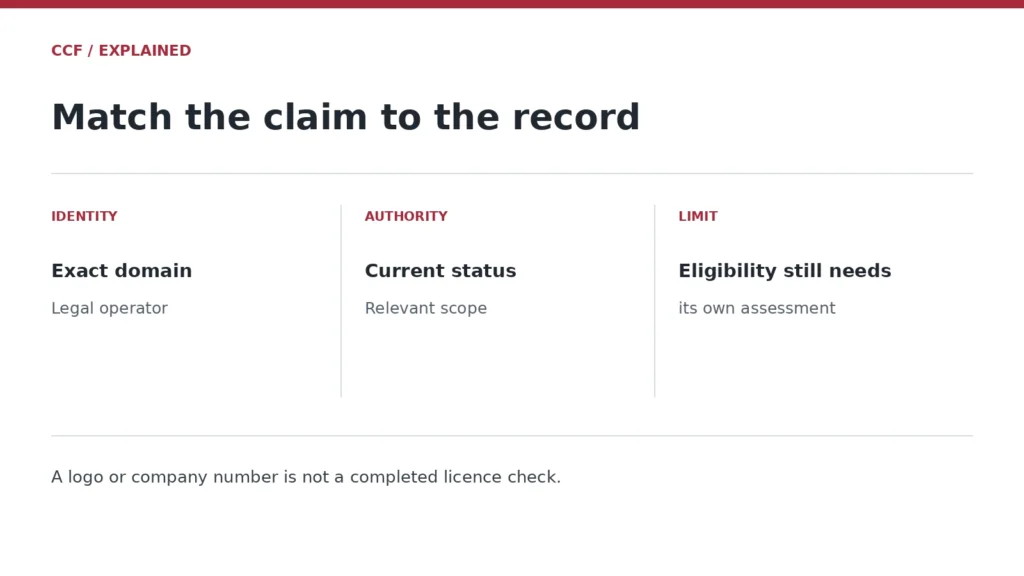
A crypto casino licence check begins with the exact website and the legal entity that says it operates it. A badge in a footer is a claim to investigate, not the completed investigation. The useful result is a documented match between a domain, an operator, a relevant authority record and the scope and status described by that record.
This guide explains a repeatable research process. It does not decide whether a particular reader may legally use a service. Location, age, product and operator restrictions require their own assessment. The casino list accompanying the article links to profiles with stated research limits; inclusion is not a certification of licensing or eligibility.
Separate brand, domain and legal entity
A brand name is how a service presents itself. A domain is the particular web address. A legal entity is the organisation identified as operating the service or providing part of it. These can differ, and a group can use more than one entity or domain. A comparison should record each separately instead of treating the brand name as the entire identity.
Read the general terms, footer and relevant legal notices together. Note the company name, registration details where supplied and the claimed licensing authority. If different pages identify different operators, preserve the discrepancy. It may reflect an update, a jurisdiction-specific service or something that needs clarification; it should not be silently resolved by choosing the most reassuring statement.
Company registration is not the same as a gambling licence
A company number can help identify an organisation. It does not, by itself, establish permission to offer a particular gambling product to a particular market. Likewise, a payment-processing entity should not automatically be treated as the licensed gambling operator. The source needs to identify the role of each company.
A useful profile therefore has separate fields for the operator statement and the licence-verification result. One field can accurately say that the terms name a company while another says that an authority match has not been completed. Combining them into “licensed and safe” would claim more than the evidence supports.
Use the authority’s own register
For a claim involving the UK Gambling Commission, its public business register supports searches using business, trading-name and domain information and displays licence-status information. For an MGA claim, the Malta Gaming Authority publishes links to its licensee register and URL checker. These are examples of authority-controlled tools; they do not establish that any operator in our comparison holds either licence.
Reach the relevant register through the authority’s official website. A logo, screenshot or certificate hosted only by the casino is not equivalent to a current authority record. Save the exact record or result URL when it is shareable, together with the date and the fields that matched.
If a register requires an interactive search and no shareable result is available, describe the search and its limitations rather than constructing a convincing-looking record URL. A review should make it possible for another reader to repeat the check, including where the evidence was incomplete.
Match more than the company name
| Field | What to compare |
|---|---|
| Legal entity | Exact operator name and any relevant company identifier |
| Domain | The website being reviewed and the domain associated with the record |
| Licence or account reference | The identifier stated by the operator and the authority |
| Status | The authority’s current status wording |
| Scope | Products or activities covered by the record |
| Research date | When the match was actually examined |
A partial match is not a complete match. An entity with a similar name may be unrelated. A sister domain may serve a different market. A record can cover a supplier or another activity rather than the consumer service being reviewed. The comparison needs to state which relationship was established, not merely that a search returned a familiar name.
Read status and scope literally
An authority can distinguish active, pending, suspended, expired or other statuses. Do not flatten these into the single word “licensed”. Use the exact relevant status meaning from the authority and record the check date. An application or historical record should not be presented as current operating permission.
Scope matters as much as status. A record might cover certain activities or products, and the operator’s particular service must be matched to that scope. A comparison should avoid using a general group relationship to imply that every game, domain or jurisdiction is covered. When the scope is unclear, identify the unresolved question.
A foreign licence is not universal eligibility
Even a successful authority match does not settle whether a person may use a service from every location. The operator’s restrictions and the rules relevant to the reader’s circumstances remain separate checks. A website loading successfully is a technical observation, not a legal conclusion.
This is especially important for country articles. A title such as “Bitcoin casinos in the USA” cannot be supported by a general country label or by evidence concerning a different sister product. A useful location comparison needs the relevant jurisdiction, product and operator evidence. Our system leaves unsupported country matches empty instead of substituting a global list.
Look for changes without assuming wrongdoing
Companies, domains and licensing arrangements can change. A different name in a new document is a reason to investigate, not automatic proof of misconduct. Record the old and new statements, their dates and any explanation supplied by the operator or authority. Avoid turning an unresolved discrepancy into an accusation.
For editorial work, use precise labels such as “operator-stated”, “authority match checked” or “not independently confirmed”. Those labels tell readers how far the research went. They are more useful than an unsupported binary verdict that a service is either completely safe or necessarily fraudulent.
Read payment and verification conditions separately
A licence record cannot answer the exact minimum withdrawal for a selected asset or the documents requested for an individual account. Those questions need the operator’s current terms, help material and, where appropriate, account-specific instructions. Keep their source dates separate from the authority check.
The KYC guide explains verification categories, while the payment comparison tool shows selected documented conditions. Linking those resources is useful because it prevents one authority record from being stretched into claims about every part of the service.
Complaint routes need the same identity discipline
Read the operator’s complaint procedure and identify the entity that receives the complaint. Then check which external route, if any, is described for that operator, licence and product. A dispute process advertised by a different brand in the same group should not be assumed to apply.
Prepare a concise factual record when a complaint is necessary: the exact domain, relevant dates, transaction or round references and the resolution requested. Use the official secure channel and avoid publishing identity documents or full account details. The existence of a complaint route does not guarantee a particular outcome or a fixed resolution time.
How to recognise weak evidence in a review
- A licence badge without a named authority or record.
- A company-registration number presented as a gambling licence.
- A reference to a related brand without an exact domain match.
- A historical status described as current without a check date.
- A broad “regulated worldwide” statement without jurisdiction-specific evidence.
- A safety score with no method or explanation of what was tested.
- A source list that points only to other affiliate articles.
None of these observations alone proves a legal violation. They indicate that the evidence is insufficient for the strength of the claim. A responsible review narrows the claim or seeks a better source. Our evidence checklist applies this approach to game, payment and bonus statements too.
A worked research scenario
Imagine a fictional brand called Example Casino whose footer names Example Operations Ltd and displays an authority logo. Its terms identify the same company, but the register result found by the researcher lists only a software-supply activity and does not identify the consumer domain. The correct conclusion is not that the consumer service’s licence has been verified. The relationship remains incomplete.
Now imagine that a second official result identifies the correct entity, exact domain, current status and relevant consumer activity. That is stronger evidence for the specific claim, but it still does not prove that the service is available to every reader or that future withdrawals will be trouble-free. The research record should explain both the successful match and the remaining questions.
The scenario is invented to illustrate the method. It does not describe an allegation about any named operator. Keeping fictional examples clearly labelled allows the article to teach a process without manufacturing reputational claims.
Frequently asked licence questions
Is a licence logo enough?
No. It is a starting claim. The useful evidence comes from matching the exact operator and service to the authority’s current record and scope. A decorative image cannot establish those details.
Does a successful match guarantee safety?
No. It supports a particular licensing statement at a particular time. Payment conditions, account access, game rules and individual eligibility require separate evidence. Avoid converting a scoped check into a guarantee.
What if the authority record cannot be confirmed?
Say that it remains unconfirmed and explain which part of the match is missing. Do not invent a licence number, assume a sister site’s record applies or treat the missing result as proof of wrongdoing. Readers can use that uncertainty as a reason to pause.
Maintain a check date that means something
The source-check date should change when someone actually revisits the evidence. A monthly headline can identify an edition, but it cannot certify a renewed authority search. Our profiles separate these dates so that a fresh-looking title does not conceal an old or incomplete check.
Use the method to understand claims and decide whether further research is needed. It is not an invitation to bypass restrictions or a promise that gambling is suitable. Our responsible gambling page provides independent support information, and the corrections page accepts public-source updates without requiring sensitive personal documents.
Sources & further reading
- UK Gambling Commission: business register ↗www.gamblingcommission.gov.uk
- Malta Gaming Authority: licensee register and URL checker ↗www.mga.org.mt
Found a factual error or an outdated term? Send a correction
Our editorial standards →